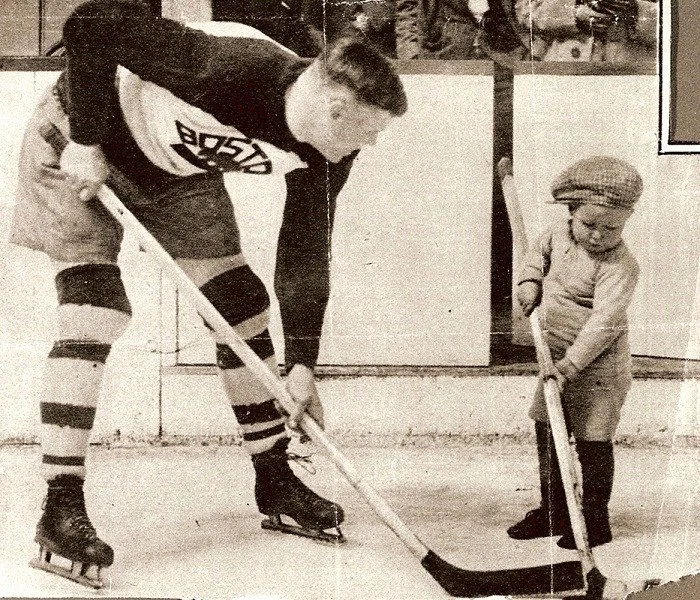
Photo courtesy of The BC Sports Hall of Fame
Frank Fredrickson
Hockey Player, Aviator
1895 – 1979
Winnipeg, Manitoba
Sigurður Franklin Friðricksson was born on June 3, 1895 in Winnipeg, Manitoba. His parents were Jón Vidalin Friðricksson and Guðlaug Sigurðardöttir. Frank spoke only Icelandic until he started primary school. Frank’s parents built an ice rink in their backyard and that is where Frank started skating at the young age of five. The Icelanders picked up the Canadian enthusiasm for hockey. At a young age, Frank played for the Lutheran Sunday School Hockey league. When Frank entered the University of Manitoba to study law, he joined the varsity hockey team and quickly became its captain. Besides being so committed to hockey and his studies, Frank played the violin in a dance orchestra to earn money to pay for his education. He joined the Winnipeg Falcons in 1913, along with a large group of lads from his Icelandic community making the Falcons a predominantly Icelandic Canadian team. The First World War interrupted their studies. In 1916, Frank, and pretty well all the Icelandic players in the team voluntarily enlisted with the Canadian Expeditionary Force.
Frank first joined the 196th Battalion and then transferred to the 223rd Battalion, joining their hockey team, along with several fellow Falcons, in time to play in the Winnipeg Amateur Patriotic League. They won! Frank scored 17 goals in six games! After being shipped overseas, Frank was transferred to the Royal Flying Corps. He was then redeployed to the British Expeditionary Force in Egypt where he became an acclaimed scout pilot. While on the journey back to serve on the Western Front, the ship he was in was torpedoed. He spent several days afloat in a collapsible lifeboat before being rescued, along with his violin. He was returned to Scotland to serve as a flight instructor and test pilot. When the war ended, Frank stopped in Iceland for several months to visit relatives. His talent as a pilot was quickly discovered and Frank agreed to fly for Iceland’s first airline, Flugfélag Ísland. On the 3rd of September 1919, Frank Fredericksson set a new record to become the first pilot of Icelandic descent to take off from Icelandic soil. Once back in Canada, Frank went back to captain the Winnipeg Falcons.
The Winnipeg Falcons and Hockey Gold at Inaugural Olympics 1920
The Winnipeg Falcons were comprised primarily of players of Icelandic descent—a group that had faced exclusion from Winnipeg’s mainstream hockey leagues due to their ethnic background. Despite these social barriers, the Falcons persevered, building a team that would go on to achieve historic success. The story of the Falcons is a testament to the strength and resilience of the Icelandic-Canadian community, whose contributions to Canadian society continue to be celebrated.
Frank Fredrickson quickly became the team’s captain, chosen for both his skill and sportsmanship. Fredrickson’s leadership was instrumental in guiding the team through provincial championships and onto the national stage. In 1920, the Winnipeg Falcons won the Allan Cup and became Canada’s amateur hockey champions. As Allan Cup winners, they were selected to represent Canada at the 1920 Summer Olympics in Antwerp, Belgium. The year 1920 marked ice hockey’s debut as an Olympic sport. The Winnipeg Falcons, as Canada’s team, dominated the competition, defeating teams from Czechoslovakia, the United States, and Sweden. Their gold medal victory marked Canada’s first Olympic hockey title—a milestone that would set the standard for future generations of Canadian teams. Fredrickson’s stellar performance, scoring multiple goals and leading by example, was pivotal to the team’s success. The Falcons’ triumph was historic: it not only marked Canada’s first Olympic gold medal in ice hockey but also highlighted the contributions of Icelandic-Canadians to the nation’s sporting legacy.
Frank went on to play professional hockey with the Victoria Cougars of the Pacific Coast Hockey Association (PCHA). In 1924, the PCHA joined the Western Canada Hockey League and Frank was key to the Victoria Cougars defeat of the Montreal Canadiens and to winning the Stanley Cup. He, and fellow Icelandic-Canadian hockey teammate, Haldor Halderson, became the first Canadians to win both an Olympic Gold Medal and a Stanley Cup. Frank went on to play in the National Hockey League (NHL) for the Detroit Cougars. He was traded to the Boston Bruins, and then to the Pittsburgh Pirates and finished his NHL career with the Detroit Falcons. He was forced to retire out of professional hockey when he sustained a knee injury. However, Frank continued to be active in hockey, working as a coach on many levels from amateur to college and professional.
In 1933, Frank accepted a coaching position at Princeton University. It was here that he crossed paths with another newcomer to the Princeton faculty—none other than Albert Einstein. Both men shared a passion for the violin. This mutual interest led them to strike up a close friendship. Frank’s tenure at Princeton was relatively brief as he decided to pursue a new opportunity and left the university to coach hockey at the University of British Columbia. Although his stay at Princeton was short, the friendship with Einstein left a lasting impression and added a fascinating episode to Frank’s varied and accomplished career.
When World War II broke out, Frank stepped up again for Canada and joined the Royal Canadian Air Force. He became a Flight Lieutenant and commanding officer of RCAF flight schools. At the same time, he volunteered to coach the air force hockey team, The Sea Island Flyers. Frank served in many locations throughout Canada, training pilots in a variety of aircraft. After the war, in 1945, he returned to his coaching position at the University of British Columbia until he retired.
Frank was a true Renaissance man. In addition to playing hockey and being a first-class pilot, Frank also played lacrosse and soccer at a very high level. He coached the Argonauts of Winnipeg Indoor Lacrosse Association in 1932 and officiated at games. He was also multi-talented as a musician. As well as being a professional violist who played with a Winnipeg orchestra, he was a pianist, a ukulele player in Pittsburgh, a talented storyteller and was once an impresario for a Minneapolis opera company. He also maintained his interest and skill as a recreational aviator and licensed transport pilot.’ He was also a writer and diarist. Frank wrote a weekly, ‘Inside Hockey’ column for the Winnipeg Free Press, as well as a series of hockey stories and insights. He was a member of the Gyro Club of Winnipeg and the American Federation of Musicians. Since he had experienced ethnic discrimination growing up, he was an outspoken advocate of fair play, inclusion, and good sportsmanship.
Frank received many honours during his life. Posthumously, he was inducted into the Canadian Hockey Hall of Fame in 1958 and the Manitoba Sports Hall of Fame and Museum (1983); the BC Sports Hall of Fame in 1983 and the Hockey Hall of Fame in 1985. In 1970, he was honoured by the Government of Iceland, for his contributions as a pioneer of Icelandic flight by being granted Knight of The Order of the Falcon.
Frank was married to Beatrice Johanna Peterson with whom he had three children: Frank Jr., Marilyn and John. Frank passed away in Toronto on May 28, 1979, at the age of 83.
Legacy
Frank Fredrickson’s achievements with the Winnipeg Falcons remain a proud chapter in Canadian sports history. The Falcons’ remarkable journey from local hockey rinks to the world stage exemplifies the ideals of perseverance, inclusivity, and community pride that are at the heart of Western Icelandic culture. The Falcons’ groundbreaking victory at the 1920 Olympic Games not only brought international acclaim, but paved the way for future generations of players from diverse backgrounds to participate in Canadian hockey.
Fredrickson’s story is celebrated for his athletic accomplishments, his courage, talent and leadership. Frank Fredrickson’s achievements with the Winnipeg Falcons remain a source of national pride. Their journey to Olympic gold exemplifies the spirit of determination and inclusivity that defines Canadian hockey. Frank brought that same talent, determination and creative energy to multiple areas from music to aviation, to community involvement. As we reflect on Frank’s legacy, we are reminded that greatness is achieved not only through talent and teamwork, but also through the courage to break down barriers and the willingness to embrace every member of our diverse nation.
Gwen Sigrid Morgan
INLNA President, 2025